Do you actually need a Faraday bag?
When signal-blocking gear is genuinely useful, when it's theater, and how to test one in thirty seconds before you trust it.
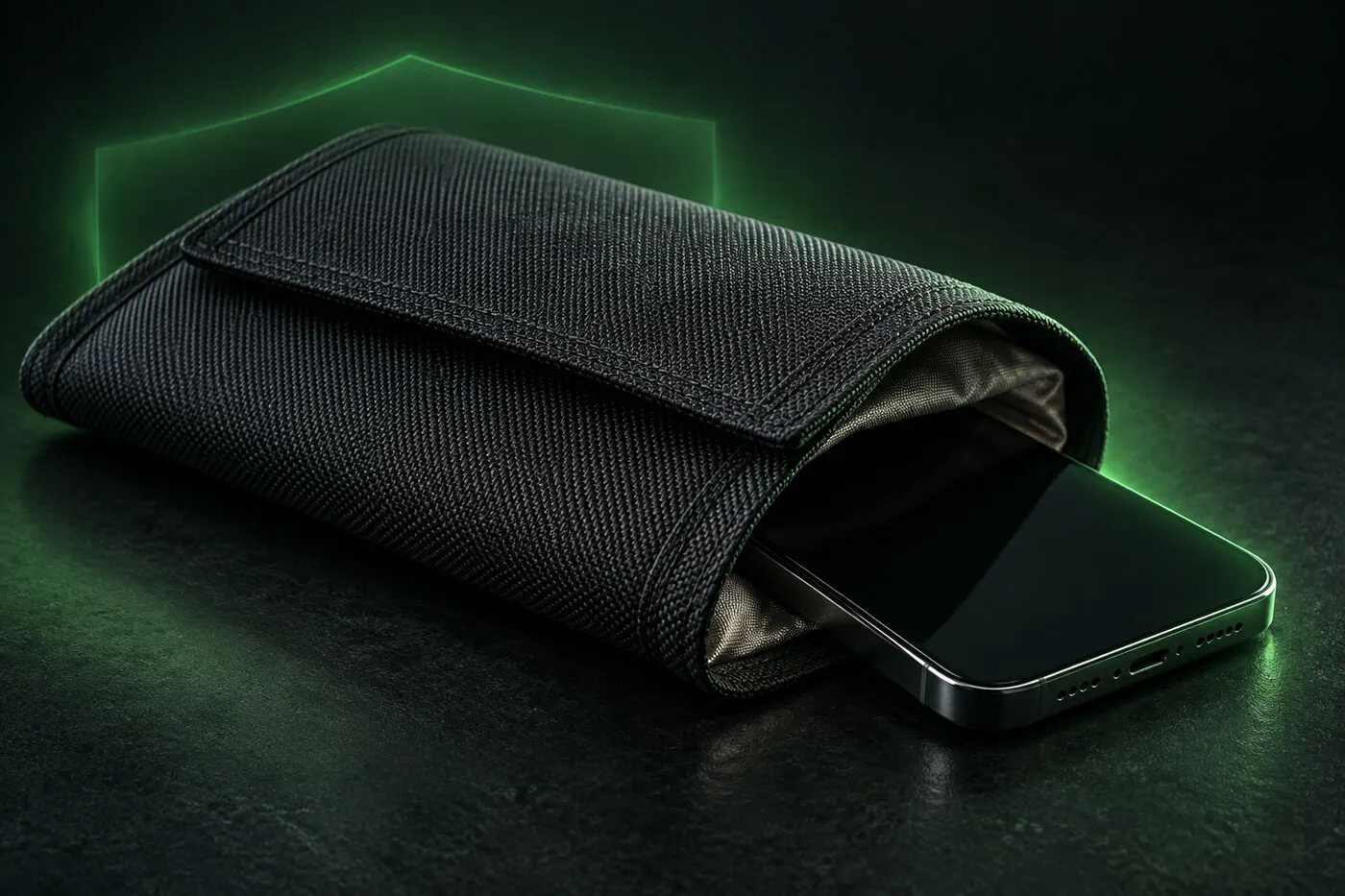
A Faraday bag is a pouch lined with conductive mesh that blocks radio in and out: no cellular, no Wi-Fi, no Bluetooth, no GPS assist, no NFC. Phone goes in, phone goes dark. They’re cheap, they genuinely work when built well — and they’re also the most over-sold item in the privacy-gear catalog. Here’s the honest sorting.
Where a Faraday bag earns its keep
Car key relay theft. The unglamorous best use case. Thieves amplify your keyless fob’s signal from outside the house to unlock and start the car. A fob-sized Faraday pouch by the front door kills the attack completely. If you own a keyless-entry car, this is a real, common crime with a €15 fix — buy one for this even if nothing else on this page applies to you.
Borders and checkpoints. A powered-off phone in a Faraday bag can’t be silently woken, pinged or located in transit, and the bag makes your “this device is off and staying off” policy legible. People who cross borders with sensitive client data (lawyers, journalists, security folks) get real value here.
Meetings where phones must be provably offline. A bag on the table is verifiable in a way “I turned it off, promise” is not.
Second/evidence phones. A device you want to stay wherever it was — untracked, unwipeable-by-remote — until you decide otherwise. This is why police evidence teams use them.
Where it’s theater
Daily anti-tracking for your main phone. The bag only works while the phone is inside it — at which point you can’t use the phone. The moment it comes out, it reconnects and uploads whatever it was going to upload. If the goal is a phone that doesn’t track you while you use it, the fix is the operating system, not an accessory. A GrapheneOS phone with per-app network toggles does more for you at lunch than a Faraday bag does in your pocket.
“Blocking radiation.” Different claim, different article, mostly marketing.
Replacing airplane mode for convenience. Airplane mode on a degoogled phone genuinely turns radios off — it’s software you can trust because you control the OS. On a stock phone, if your threat model includes the OS itself lying about radio state, you don’t have a bag problem; you have a phone problem. Same conclusion as above.
The thirty-second test
Cheap bags fail at the seams, and every bag fails when worn out. Test before trusting, and re-test occasionally:
- Put the phone in, seal it properly (usually fold-and-velcro — a magnet closure alone is a red flag).
- Call it. Straight to voicemail = cellular blocked.
- From another device, scan for it on Bluetooth — it should vanish. Bluetooth is low-power and the first thing a worn bag leaks.
- For keyless fobs: seal the fob, stand next to the car, pull the door handle. It should stay locked.
Get the next guide in your inbox
One email a week: new degoogling guides, OS and device-support news that matters, and one privacy fix you can do in five minutes. No tracking pixels.
If you’re buying one
What matters: dual-layer shielding (single-layer pouches fail the Bluetooth test disturbingly often), a fold-over closure, and honest sizing — a bag that barely fits the phone gets stressed at the seams and dies early. Brand matters less than those three things plus the test above.
Quick answers
Does a Faraday bag drain the battery? It can. A phone that loses signal keeps searching for a tower, and searching costs power. If the phone will sit in the bag for hours, switch it off or put it in airplane mode first. The bag then becomes a backstop rather than the only thing keeping the radios quiet.
Will calls and messages arrive later? Yes. The network holds texts and voicemail, and they come through once the phone is out of the bag and connected again. Nothing is lost; it is just delayed.
Does it stop “Find My Device” from finding a stolen phone? While the phone is sealed, yes. That cuts both ways: it is the point for evidence phones, and a drawback if it is your own phone that goes missing inside the bag.
Does it work against 5G and newer bands? A well-made, multi-layer bag should, but don’t take the label’s word for it. The thirty-second test above is the only check that matters, and it costs nothing.
Who this is for
If you drive a keyless car, travel with client data, or run meetings where phones must be offline, a bag is a sensible, cheap purchase. If you mostly want less tracking day to day, start with the phone itself: a degoogled operating system and a settings lockdown help every hour you use it, not only the hours it spends sealed away.
Faraday bags on Amazon
affiliate link — same price for you, small commission for us